
Description of the Numbered Sections
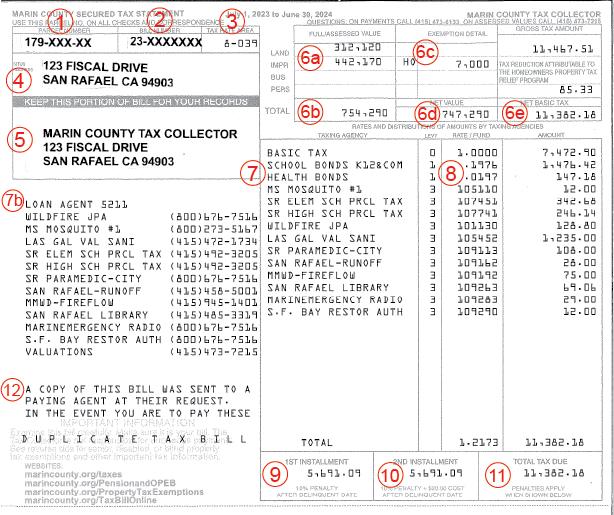
Section #1 - Assessor Parcel Number
Section #2 - Bill Number- This is a 9-digit number that uniquely identifies a property's tax bill.
Section #3 - Tax Rate Area (TRA): a specific geographic area all of which is within the jurisdiction of the same combination of local agencies and school entities for the current fiscal year.
Section #4 - Situs Address - The site address of the subject property, address of the home, building, or vacant lot
Section #5 -The owner of record information and mailing address. *To update your address, contact the assessor’s office.
Section #6a - Full/Assessed value - This includes:
- Land- This is the Prop 13 assessed value of the land. This may not be the actual market value.
- Improvement (Impr.) This the Prop 13 value assessment of all structural improvements. This may include residences, garages, sheds, decking, barns, heating and cooling systems, etc.
- Business (Bus.)
- Personal (Perso.)
Section #6b -Total assessed value
Section #6c - Exemption Detail
Section #6d - Net Value: the Gross Taxable Value of your property less any exemptions.
Section #6e - Net Basic Tax
Section #7 - Rate and distribution of amounts by taxing agencies. Direct Charges/ GEO Bonds and/or Special Assessments Note: There are no exemptions for bonds.
Section #7b - This section contains contact information for agencies that are applying voter approved direct charges and taxes. Any questions concerning the charges for these agencies should be directed to the agency themselves. Each agency has a contact phone number on your tax bill.
Section #8 - Tax Rate
The annual tax rate is recommended by the Controller, adopted and approved by the Board of Supervisors. The Tax Rate varies slightly from year to year.
Section #9 - First installment - This is the amount due in your first installment. It is due November 1 but delinquent after December 10.
Section #10 - Second installment- This is the amount due for your 2nd installment. It is due February 1 but delinquent after April 10.
Section #11 - Total Tax due - this rate is figured by taking your Net Taxable Value and multiplying it by the Tax Rate and then adding any Total Direct Charges and Special Assessments. The total due is divided into two equal installments.
Section #12 - Copy sent to Agent: If you have an impound account and/or someone else is paying the installments then they will receive a copy of your tax bill.
- LAND: The assessed value of the land portion of a property.
- IMPROVEMENTS: Defined in California law as:
- buildings, structures, fixtures, and fences erected on or affixed to the land
- PERSONAL PROPERTY: Any property which is not designated by law as real property.
- EXEMPTIONS: Freed from an obligation or duty required by others. According to California Revenue and Taxation Code 201.2 through 234, certain property owners are freed of all or a portion of their tax obligation.
-
NET ASSESSED VALUE: The taxable value of a property against which the tax rate is applied (Assessed Value minus any exemptions).
Assessed Value - For more information on how the assessed value is determined, contact the Marin County Assessor’s Office
-
The County Assessor assesses the property. Additional information is available https://www.marincounty.org/depts/ar
- The County Auditor calculates property tax due based on:
- Secured Property is taxed at a rate of 1% of its assessed value.
- Taxes for voter approved bonds and direct charges for special assessments.
- Tax collections are verified by the Auditor and apportioned to local taxing jurisdictions.
-
The County Tax Collector mails property tax bills and collects the taxes owed.